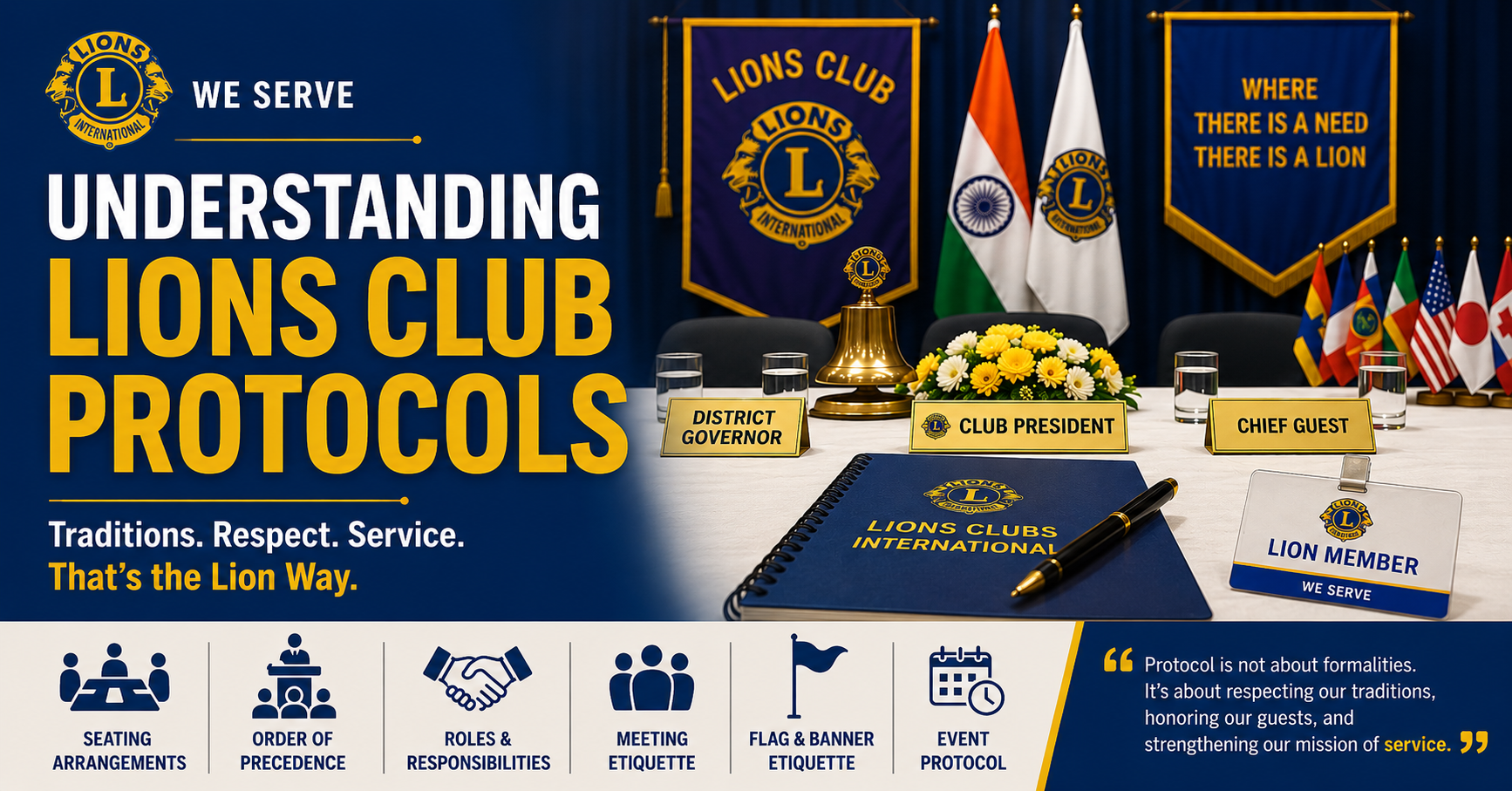
Lions Clubs around the world are united by a common purpose—service. Alongside service projects and community engagement, Lions Clubs follow established protocols that promote respect, order, and professionalism during meetings and official events.
Understanding these protocols helps members conduct meetings efficiently, honour guests appropriately, and maintain the dignity of the organisation. Whether you are a new Lion, Club Officer, or an experienced member, familiarity with these traditions strengthens the spirit of Lionism.
Why Protocol Matters
Protocol is not about hierarchy or status; it is about showing respect for positions of responsibility and ensuring that events run smoothly.
Proper protocol:
- Creates a professional atmosphere.
- Shows respect to visiting dignitaries and guests.
- Maintains consistency across Lions Clubs worldwide.
- Helps meetings proceed efficiently.
- Preserves Lions traditions.
Standard Order of Precedence
During official functions, Lions are recognized according to their office. While local customs may vary, a typical order of precedence is:
- International President
- Past International Presidents
- International Vice Presidents
- International Directors
- Past International Directors
- Multiple District Council Chairperson
- District Governor
- Immediate Past District Governor
- First Vice District Governor
- Second Vice District Governor
- Region Chairperson (where applicable)
- Zone Chairperson
- Club President
- Immediate Past Club President
- First Vice President
- Second Vice President
- Club Secretary
- Club Treasurer
- Membership Chairperson
- Service Chairperson
- Leadership Chairperson
- Marketing Chairperson
- LCIF Chairperson
- Tail Twister
- Lion Tamer
- Board Directors
- General Members
Always verify the current protocol order with your DCS if special circumstances apply.
The Head Table Seating Arrangement
For official meetings, charter nights, installations, or visits by District Officers, a head table is commonly used.
Basic Principle
The most senior guest is seated immediately to the right of the Club President.
Example arrangement:
Audience View:
District Governor | Club President | Chief Guest
Additional dignitaries are seated alternately outward from the centre according to protocol.
Example:
Past District Governor | First Vice District Governor | District Governor | Club President | Chief Guest | Zone Chairperson | Club Secretary
General guidelines:
- The Club President always occupies the centre position.
- The principal guest sits on the President’s right.
- The second-ranking guest sits on the President’s left.
- Spouses may be seated together if appropriate.
- Avoid overcrowding the head table.
- Only those with active roles should sit at the head table.
Introducing Dignitaries
Introductions should follow protocol order, beginning with the lowest-ranking official and concluding with the highest-ranking dignitary.
For example:
“Please join me in welcoming our Zone Chairperson, our Past District Governor, and finally our District Governor.”
The highest-ranking guest should normally be introduced last.
Avoid lengthy biographies unless the occasion specifically calls for them.
Speaking Protocol
A typical speaking order is:
- Club President opens the meeting.
- Secretary presents announcements.
- Committee reports are delivered.
- Guest introductions are made.
- Guest speaker addresses the audience.
- Principal dignitary speaks.
- Vote of thanks is delivered.
- Club President closes the meeting.
General speaking etiquette:
- Keep remarks concise.
- Respect allotted time limits.
- Avoid interrupting speakers.
- Silence mobile phones.
- Stand when addressing the audience whenever practical.
Proper Use of Lions Titles
Use official titles during formal occasions.
Examples:
- Lion John Smith
- President Jane Doe
- District Governor Sarah Patel
- Past District Governor Michael Lee
Avoid overusing titles repeatedly during informal discussions.
Once introduced, using “Lion John” or simply the person’s name is acceptable in many settings.
Flag and Banner Etiquette
If national and Lions flags are displayed:
- The national flag occupies the position of honour.
- The Lions flag is placed beside it according to local customs.
- Club banners should be displayed neatly and prominently.
- Ensure all banners are current and in good condition.
Dress Code Guidelines
Formal Events:
- Business suit or formal attire.
- Lions pin displayed prominently.
- Name badge worn correctly.
Regular Club Meetings:
- Smart business casual attire.
- Club polo shirts where appropriate.
Service Projects:
- Club-branded shirts or uniforms.
- Comfortable and practical clothing.
Members should always represent Lions with professionalism.
Meeting Etiquette Every Lion Should Remember
Do:
✓ Arrive early.
✓ Wear your Lions pin and name badge.
✓ Welcome visitors warmly.
✓ Participate actively.
✓ Respect speaking times.
✓ Follow the agenda.
✓ Assist new members.
Avoid:
✗ Side conversations during presentations.
✗ Using mobile phones during meetings.
✗ Interrupting speakers.
✗ Arriving late without necessity.
✗ Dominating discussions.
✗ Ignoring guests or visitors.
The Role of the Tail Twister
The Tail Twister helps maintain fellowship and enthusiasm.
Responsibilities may include:
- Encouraging participation.
- Conducting light-hearted fines.
- Promoting camaraderie.
- Maintaining a positive atmosphere.
The role should always be conducted respectfully and never embarrass members.
The Role of the Lion Tamer
The Lion Tamer is responsible for:
- Preparing meeting materials.
- Maintaining club property.
- Managing flags, banners, and equipment.
- Assisting with room setup.
This role ensures meetings run smoothly behind the scenes.
Final Thoughts
Protocol is not about formality for its own sake. It reflects the values Lions stand for: respect, service, leadership, and fellowship.
When members understand and follow these traditions, meetings become more organized, guests feel valued, and the image of Lions Clubs remains strong within our communities.
As Lions, we serve with compassion, lead with integrity, and honour the traditions that connect us with more than a century of global service.
Always remember – KINDNESS MATTERS!